

Black Cats and Their Mistresses
Through November 16, the Musée de Pont-Aven in France is presenting the exhibition Sorcieres (Witches), which explores witch iconography between 1860 and 1920. The show brings together an extraordinary range of artworks, from symbolist visions to scenes of superstition and folklore, all focused on the image of the witch and her mysterious companions.
Among the many fascinating works on view, two deserve special attention for how closely they reflect one another. They come from different countries and artistic traditions, yet both share the same symbolic presence. The black cat.
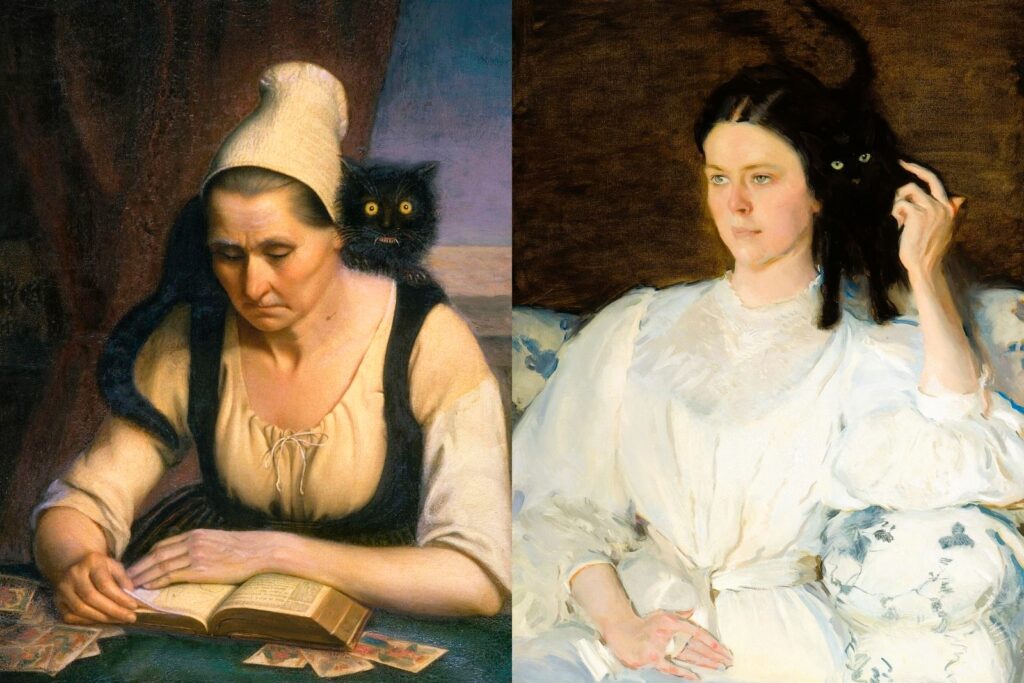
Before we look at these two paintings and their curious connection, it helps to ask where this story began. How did this graceful animal, once admired and even sacred, become linked with witchcraft and evil in both art and legend?
Where the Black Cat’s Story Begins
The roots of black cats’ dark reputation do not come from folklore. They begin instead with church politics and a wave of medieval paranoia.
In 1233, Pope Gregory IX, infamous for establishing the Papal Inquisition, issued a bull titled Vox in Rama. It remains one of the strangest episodes in the history of Christian demonology. In this document, the pontiff condemned a supposed satanic cult whose rituals allegedly included kissing a cat as a symbol of the devil.
There is, of course, no historical evidence that such a cult ever existed. Most historians see Vox in Rama as a product of rumor, accusation, and hysteria, a political weapon aimed at heretics rather than pagans. But the consequences were lasting. The bull gave official shape to the fear of the black cat, linking it to the devil, to night rituals, and to witchcraft.
An animal once sacred in Egypt and cherished in the classical world as a household companion now became a sign of darkness. Medieval Europe took the idea literally. Black cats were hunted, burned, and drowned, blamed for plagues, storms, and bad luck.
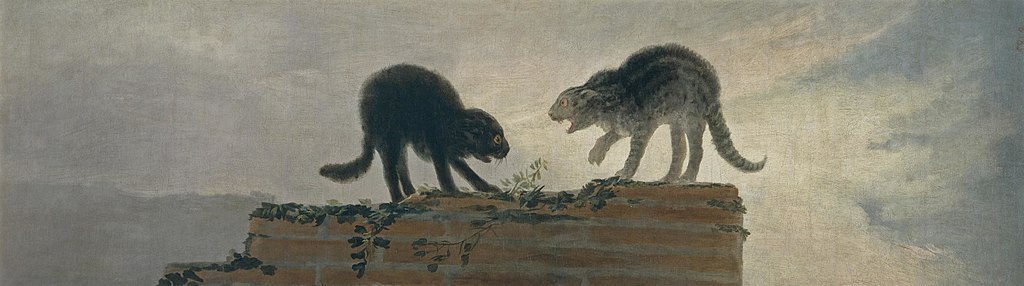
Art quickly absorbed the image. In illuminated manuscripts, engravings, and later in paintings, the black cat appears beside cauldrons, decks of cards, spell books, or witches themselves. A visual cliché was born: the cat as a sign of danger, magic, or temptation.
Ironically, Vox in Rama never explicitly declared cats to be demonic creatures or called for their extermination. But the myth took on a life of its own. Even today, popular blogs and articles repeat the legend that a papal bull once branded cats as symbols of Satan and heresy.
Over time, this fear evolved into a visual language that shifted from demonization to symbolism. By the nineteenth and early twentieth centuries, a pair of glowing eyes in dark fur no longer meant the devil’s presence. It had become an emblem of mystery, feminine independence, and secret knowledge.
The Fortune Teller and Her Cat
In art history, it is rare to find an artist remembered for just one painting. But that’s exactly the case with Clémentine Dondey de Sainteny, a little-known 19th-century French painter who once showed her work at the Paris Salon. Late in life, she donated three of her own paintings to the Musée des Beaux-Arts in Dijon. Among them was this striking and almost forgotten work, Fortune Teller Studying a Book of Necromancy, sometimes also called The Card Reader.
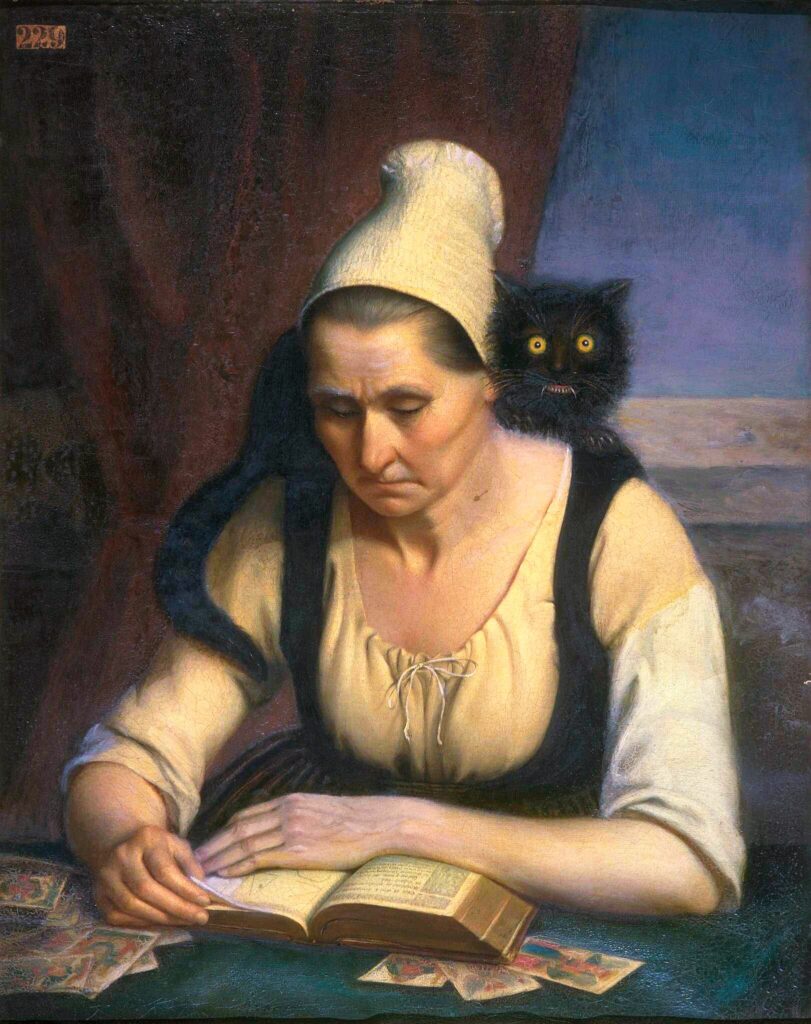
Restored by the Dijon museum in 1987, the painting feels surprisingly current. To a modern viewer, it could almost be a meme. The calm, thoughtful figure of an older woman reading contrasts sharply with the black cat beside her, fanged, yellow-eyed, and hypnotic as it stares straight at us. The effect is both funny and unsettling, as if the cat had been dropped into the scene at the last minute. Take the cat away, and you’d have to search the whole composition for any hint of witchcraft or superstition, right?
But look closer. There’s a skull hiding in the shadows, peeking from behind the red curtain in the corner. Bet you didn’t notice the skull until we mentioned it.
The painting is mysterious, much like the life of its creator. Clémentine Dondey lived nearly eighty years but left behind almost nothing. No diaries, no letters, no record of her artistic journey. What remains is this unforgettable image: an elderly woman reading and a strange, almost cartoonish cat.
Sita and Sarita
If the previous painting feels a little uneasy in how it pairs a woman and her cat, this one is the complete opposite. Here everything flows together. The black cat on the woman’s shoulder almost blends into her dark hair, as if the two are part of the same calm rhythm.
Sita and Sarita by American painter Cecilia Beaux shows her cousin, Sarah Allibone Leavitt. The title has a touch of affection. “Sarita” is a Spanish nickname for Sarah, and “Sita” refers to the cat, the little one.
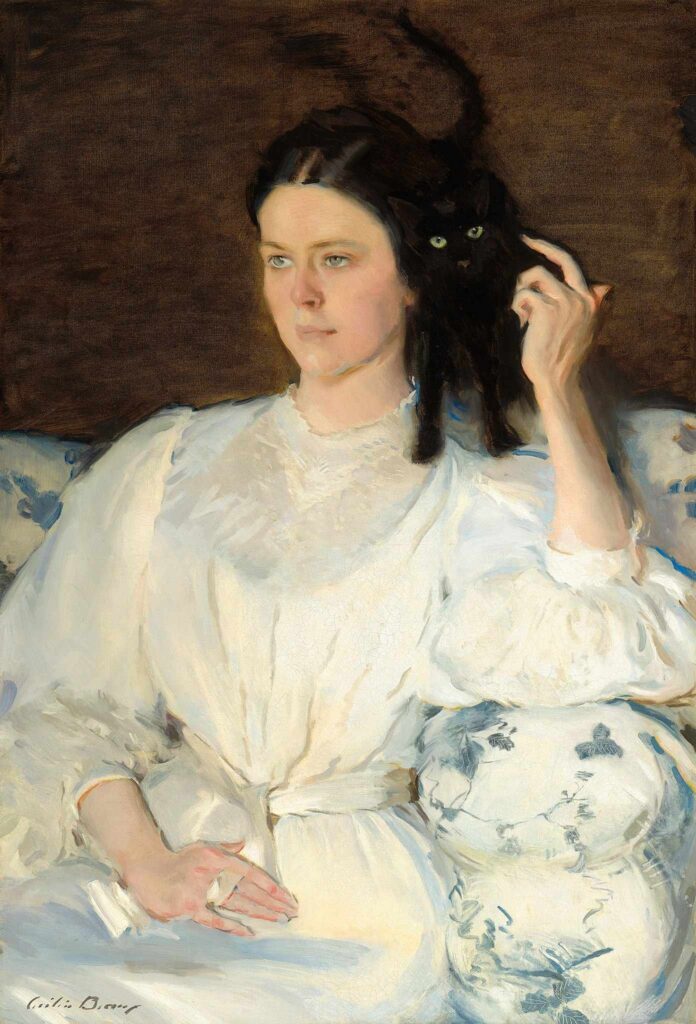
There are actually two versions of this painting. The first, created in Paris around 1893 or 1894, was later donated to France and now hangs in the Musée d’Orsay. A second version, painted soon after, is in the National Gallery of Art in Washington, D.C.
Art historians often point out how the woman in white here recalls Whistler’s Symphony in White No. 1, while the cat reminds them of the one in Manet’s Olympia. That connection makes sense.
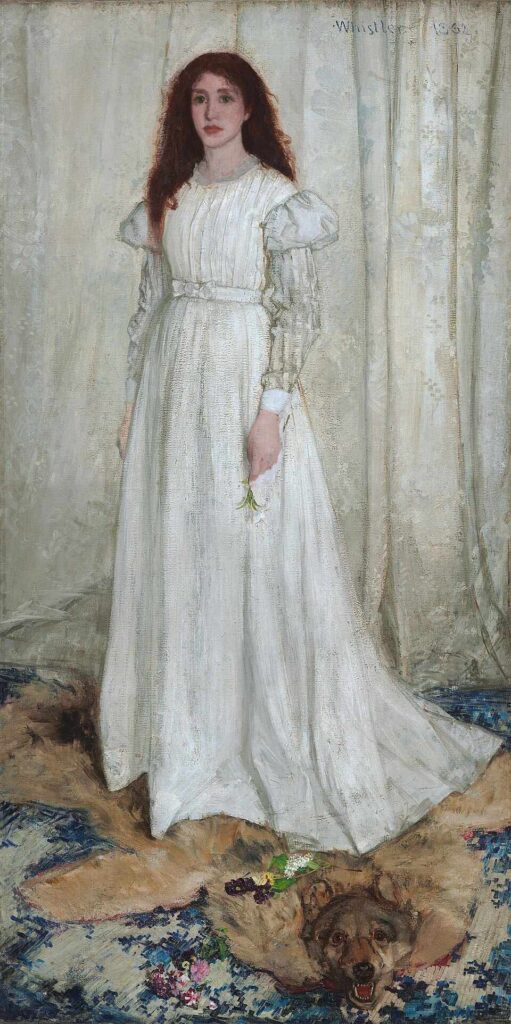
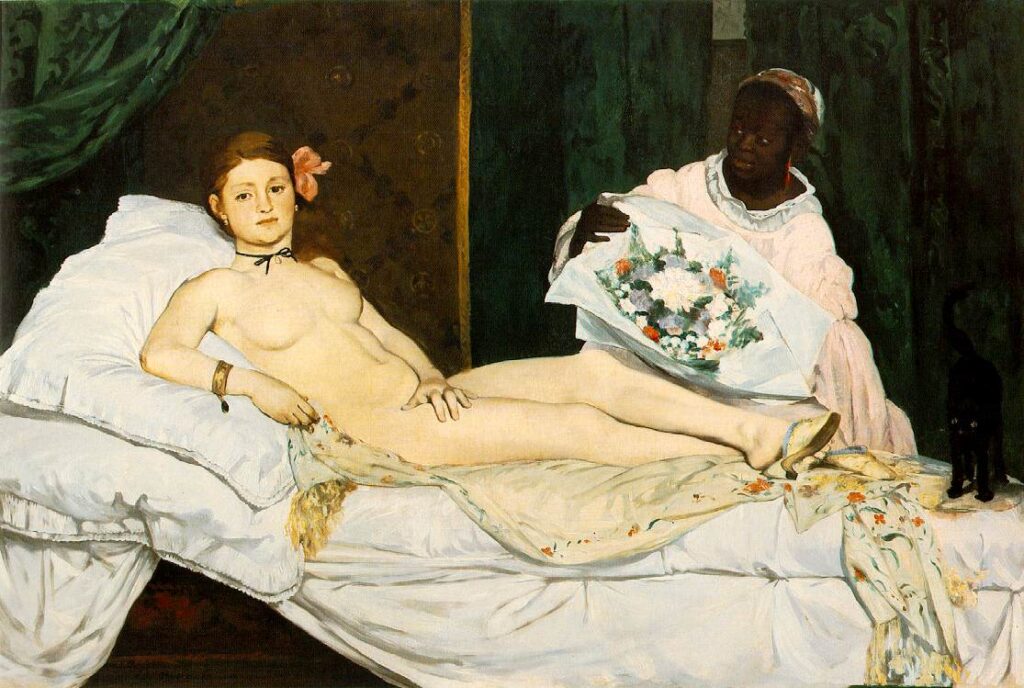
But if you look a little longer, don’t you start to see something else? The pose, the quiet stillness, the way the cat looks straight at us. Could this be a subtle nod to Clémentine Dondey’s Fortune Teller Studying a Book of Necromancy?
In both paintings the women look away, deep in thought, while the cats lock eyes with us. Their gaze feels calm, curious, and almost too aware. Could Beaux have seen Dondey’s work? Maybe. Dondey died when Beaux was forty-seven. By that time Beaux was already well known, studying and exhibiting in Paris, and moving in circles where Dondey’s name might have been familiar.
The more you look at these paintings, the contrast of light and dark, the women and their watchful cats, the more it feels like the same mysterious creature has slipped from one canvas into another and carried its quiet magic along.
Epilogue
Two artists, two very different lives. One might have been forgotten if a museum hadn’t decided, nearly a century later, to restore her painting from the depths of its archive. The other was celebrated enough to have her self-portrait included in the permanent collection of the Uffizi Gallery in Florence.
Their paintings seem to speak to each other. Women and their demonic cats. A quiet duet across time. In our imaginary museum, they would certainly hang side by side. And while we are at it, wouldn’t Frida Kahlo’s Self-Portrait with Thorn Necklace and Hummingbird fit perfectly into that row?
.jpg)
The exhibition Sorcieres (Witches) offers a fascinating mix of images and symbols. We haven’t made it to the show yet, but after spending some time with the catalog, we can highly recommend it.
Sorcieres: Fantasmes, savoirs, liberté / Witches: Fantasies, Knowledge, Freedom
Exhibition calendar
17 Sep 2026
European Art Exhibitions: Fall 2026
Europe’s fall exhibition season is officially underway, and this year there really is something…
Art news
03 Oct 2025
Double Portrait of a Giant and a Dwarf
“Dwarfs” and “giants” were long seen as curiosities of nature. In the Middle Ages…
Exhibition highlights

10 Jun 2026
The Mysteries of the Bearded Woman’s Portrait
Through June 14, Brussels is hosting Bellezza e bruttezza, an exhibition exploring ideas of…
Best catalogs

Io sono Leonor Fini / I am Leonor Fini
$67.00

Unforgettable: Women Artists from Antwerp to Amsterdam, 1600–1750
$57.00
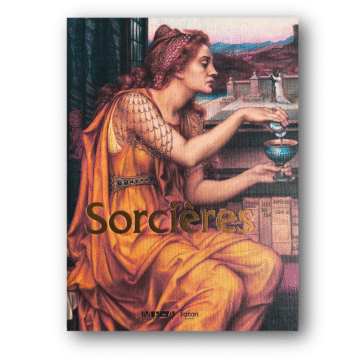
Sorcieres: Fantasmes, savoirs, liberté / Witches: Fantasies, Knowledge, Freedom
$75.50
Goya: Drawings
$87.00