

The Mysteries of the Bearded Woman’s Portrait
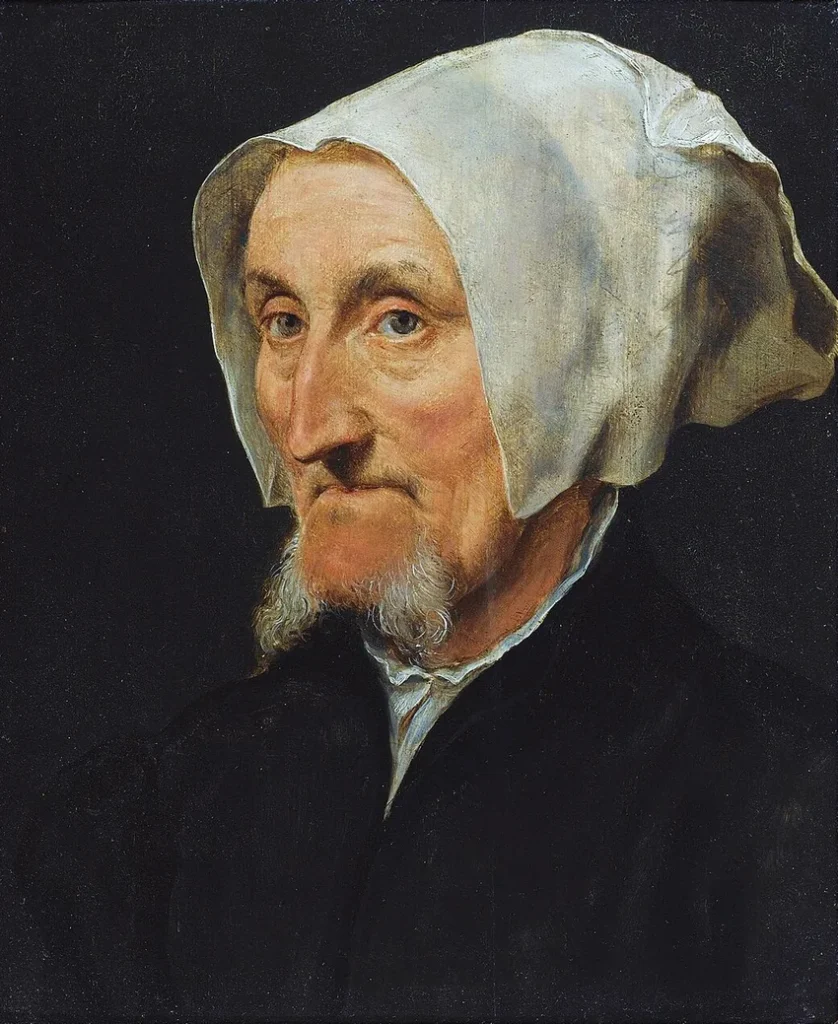
Through June 14, Brussels is hosting Bellezza e bruttezza, an exhibition exploring ideas of beauty and ugliness in sixteenth-century art. Among the more than ninety works on display, there is one small portrait that invites a longer look than most. It depicts an elderly bearded woman. The painting’s story is every bit as mysterious as the woman herself.
The Portrait That Was Stolen
June 1972. Two people walk into the Suermondt-Ludwig Museum in Aachen, Germany. Before long, one of them starts a loud argument with a security guard in a nearby gallery. While the guard’s attention is diverted, the second visitor acts quickly and efficiently. He removes a small wooden panel from the wall, takes it out of its frame, and disappears. By the time the guard returns, only the empty frame remains.
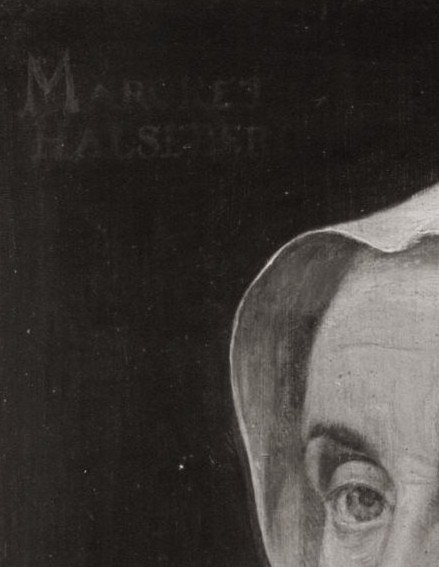
Police were never able to determine whether the two individuals knew each other. The theft was never solved. The painting has never been seen again. All that survives today is a black-and-white photograph. It shows the portrait of an elderly woman with a forked beard.
Portrait of Margret Halseber, also known as The Woman with Two Beards, is attributed to the sixteenth-century Flemish painter Willem Key. Today, it is considered one of the most intriguing lost paintings of the Northern Renaissance. The story behind the portrait reads like an art-historical detective story. It spans several centuries and brings together the Habsburg court, collectors of curiosities, court painters, missing originals, and a Christie’s auction more than fifty years after the painting’s disappearance.
The woman portrayed in the painting was named Margret Halseber, or Halscher, as her name sometimes appears in older sources. That name was recorded on the version of the portrait stolen from the Aachen museum.
She lived in Basel and, judging by her appearance in the painting, likely suffered from hirsutism, a condition that causes excessive facial and body hair growth in women. Today, medicine can easily explain such cases through hormonal disorders. To a sixteenth-century viewer, however, her appearance would have carried very different meanings. Modern audiences often see images like this through the lens of medical anomaly, social stigma, or personal tragedy. Renaissance viewers approached them in a far more complex way.
The sixteenth century was an age of almost boundless curiosity about the world. Europeans collected far more than paintings and classical antiquities. Anything unusual attracted attention: rare minerals, stuffed exotic animals, narwhal tusks believed to be unicorn horns, images of dwarfs and people with unusual physical traits, and countless other “wonders of nature.” It was also the era that gave rise to the famous cabinets of curiosities, collections where art, science, medicine, and a nearly childlike sense of wonder coexisted side by side. A bearded woman fit perfectly into that world.
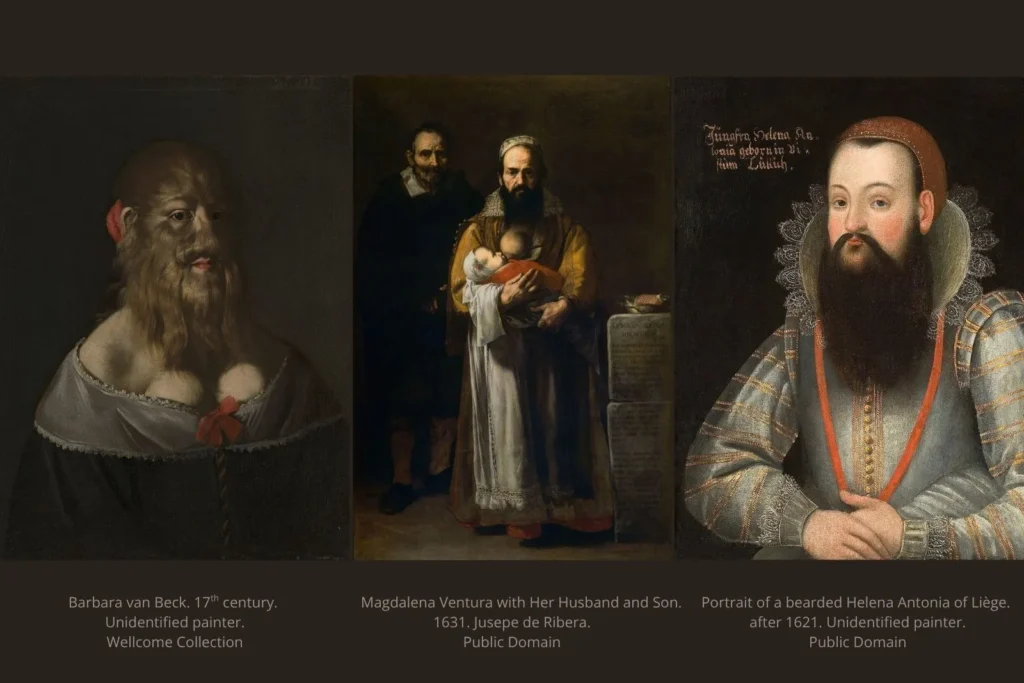
Interest in such subjects did not disappear with the Renaissance. Nearly a century after the portrait of Margret Halseber was painted, images of women with hirsutism began appearing much more frequently in European art. One of the most famous examples is Jusepe de Ribera’s monumental portrait of Magdalena Ventura, painted in 1631 for the Viceroy of Naples. Ribera portrays Magdalena alongside her husband and child, presenting her almost as a living marvel of nature. At the same time, he imbues the image with a striking sense of dignity. Around the same period, portraits of Barbara van Beck, who traveled across Europe as the “Bearded Lady,” and Helena Antonia of Liège also began to circulate. Their unusual appearance attracted fascination at aristocratic courts and among collectors of curiosities throughout the seventeenth century.
Margret Halseber’s portrait is particularly significant for another reason. It may well be one of the earliest, if not the earliest known portrait of a woman with hirsutism in Northern Renaissance art.
The painting’s provenance has been partially reconstructed. It is known to have belonged to a collector in Aachen and was likely acquired by the German banker and art collector Barthold Suermondt at a sale in Brussels in 1875. In 1882, Suermondt donated a substantial portion of his collection to the city of Aachen. That gift became the foundation of what is now the Suermondt-Ludwig Museum. The portrait of Margret Halseber remained there for nearly a century. Until that day in June 1972, when someone removed it from its frame and vanished without a trace.
The Portrait That Was Sold
Summer 2025. A small sixteenth-century Northern European portrait appears at a Christie’s auction. It depicts an elderly woman dressed in black, wearing a white cap and sporting an unexpectedly thick beard. The bidding climbs quickly. The painting sold for nearly $1 million. But wait. Wasn’t this portrait stolen from a museum in Aachen back in 1972? The woman certainly looks familiar. There she is again, with the same striking appearance. One detail, however, is missing. The Christie’s panel bears no inscription. Gone is the name that had identified the sitter as Margret Halseber for decades.
It turns out that the painting stolen from the Suermondt-Ludwig Museum was not the only known portrait of Margret Halseber. In fact, researchers and collectors appear to have known about several nearly identical versions of the composition as early as the nineteenth century. Another version survives in the Alte Pinakothek in Munich, where it is cataloged as Kopie nach Willem Key (“copy after Willem Key”). This panel is far less well known. It is rarely reproduced in publications and seldom appears in discussions of the painting. Its very existence, however, changes the story dramatically. Because we are no longer dealing with two similar portraits. There are at least three. One version disappeared from a museum in Aachen. Another remained in private hands, passing from one collection to another and resurfacing at major auctions before ultimately approaching the $1 million mark at Christie’s, while a third has sat quietly in Munich for more than two centuries.
The painting sold at Christie’s in 2025 had a completely separate history of its own. Traces of it can be found in European collections of the eighteenth and nineteenth centuries. Over the years, it passed through aristocratic collections, auction sales, and private cabinets of art. Its ownership was not the only thing that changed. So did its attribution. At various times, the portrait was attributed to Hans Holbein the Younger, then to Anthonis Mor, and eventually to Willem Key. The same painting had already appeared at Sotheby’s in Amsterdam in 2008. Christie’s, however, took the story a step further in 2025. The auction house cautiously proposed that its panel might represent the prime version of the composition, the principal authorial version created by Willem Key himself. That suggestion challenged a long-standing assumption. For decades, the version stolen from the Aachen museum had generally been regarded as the primary and most important version of the portrait.
To understand why Christie’s believes its painting may represent the prime version of the composition, we need to introduce another key figure in this story.
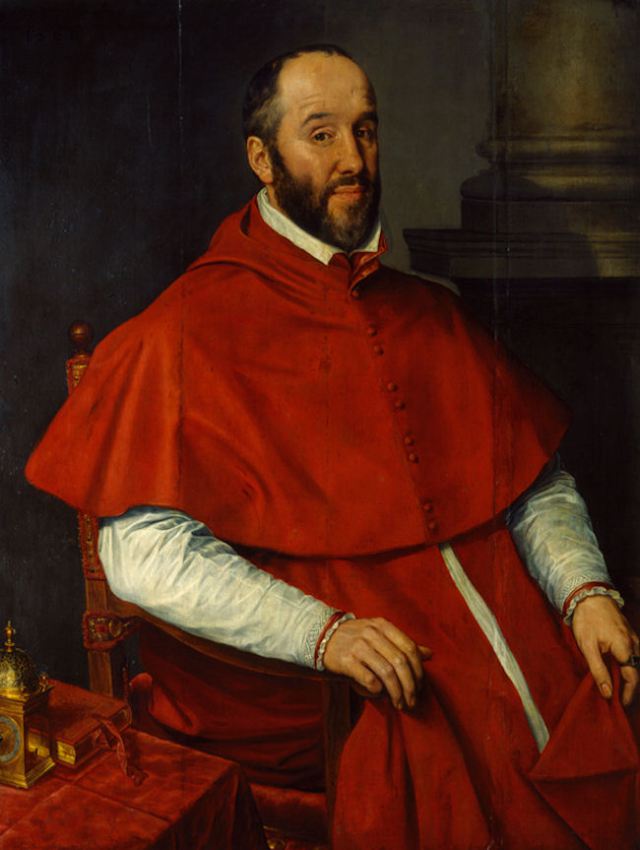
In the sixteenth century lived a man whose name now appears in nearly every study of this portrait: Cardinal Antoine Perrenot de Granvelle. An advisor to Holy Roman Emperor Charles V and to Philip II of Habsburg, King of Spain, and a close associate of Margaret of Parma, who governed the Habsburg Netherlands on behalf of the Spanish Crown, Granvelle was also one of the great collectors of his age. His collection included paintings, classical antiquities, medals, manuscripts, and the many “wonders of nature” so prized during the Renaissance. He was also known to commission portraits of people with unusual physical characteristics.
In 1931, the French art historian Louis Dimier noticed a curious connection between the portrait of Margret Halseber and a reference found in the archival inventories of Cardinal Granvelle’s collection. Among the entries was a painting described as the Head of a Bearded Woman, attributed to an artist named Guillaume Chayez. The description matched remarkably well. The subject, the approximate date, and the overall circumstances all seemed to point to the same work. One detail, however, was missing. Granvelle’s inventory makes no mention of an inscription identifying the sitter. There is no reference to Margret Halseber, or to any name at all. So which version should be considered the primary one? The painting stolen from the Aachen museum, the only version known to have carried the name Margret Halseber? Or the unsigned and unidentified version that resurfaced on the art market, but which some researchers now associate with the collection of Cardinal Granvelle?
Christie’s added yet another piece to the puzzle. Technical examination of the auction panel revealed an underdrawing beneath the paint surface. According to the auction house, this preliminary drawing appears consistent with the work of the artist himself and may indicate that the panel was created in the master’s own hand rather than copied from another version. The mystery only deepened. Because another question now demanded an answer.
Who was this enigmatic artist known as Guillaume Chayez?
Guillaume Chayez or Willem Key?
Art history knows no painter by the name of Guillaume Chayez. No signed paintings by such an artist have survived. There are no records of a workshop, no known pupils, and no documented artistic legacy. Yet it was this mysterious name that caught the attention of the French art historian Louis Dimier in 1931 and set the investigation in motion. As Dimier compared the description of the painting, Granvelle’s circle of acquaintances, and the artistic environment of the Habsburg Netherlands in the mid-sixteenth century, he arrived at a striking conclusion. The enigmatic Guillaume Chayez may never have existed as a separate artist at all. Instead, Dimier suggested that the name was likely a corrupted French form of Willem Key.
At first glance, the idea seems bold. The sixteenth century, however, had a far more fluid relationship with personal names than we do today. The Habsburg Netherlands was a multilingual world where Dutch dialects, French, Spanish, Latin, and German coexisted and often overlapped. It was not unusual for the same individual to appear in different documents under different versions of the same name. This is where Willem Key first enters the story of Margret Halseber’s portrait.
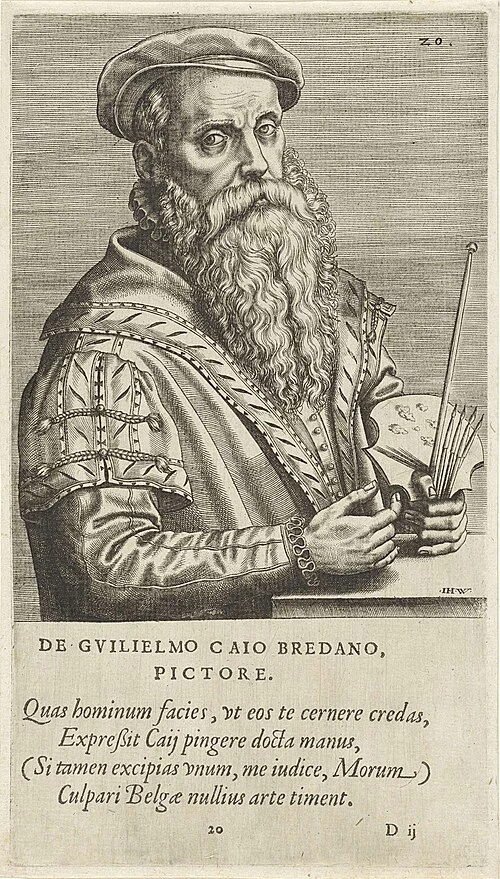
Today, Willem Key is far less familiar to most art lovers than many of the leading painters of his time. In the mid-sixteenth century, however, he was regarded as one of the most sought-after portrait painters in the Netherlands. The scale of his artistic legacy becomes clear from the catalogue raisonné published in 2011 by the art historian Koenraad Jonckheere. It lists approximately 110 surviving works and workshop copies, along with nearly one hundred additional paintings whose attribution remains uncertain.
Willem Key was born in Breda in 1516 into the family of a goldsmith. He later moved to Antwerp, a city that was rapidly emerging as the commercial and artistic capital of Northern Europe. It was there that his career took shape. According to Karel van Mander, often described as the “Vasari of the Northern Renaissance,” Key quickly became one of Antwerp’s most respected citizens. Van Mander portrays him as a man of impeccable appearance, elegantly dressed and living in one of the city’s most prestigious neighborhoods. In his words, Key looked more like a civic dignitary than an artist.
Willem Key’s portraits were not seen simply as the work of a skilled craftsman. He was regarded as an educated intellectual and a member of Antwerp’s urban elite. Judging from the surviving works, that reputation was well deserved. His patrons included not only wealthy Antwerp citizens but also members of the highest ranks of Habsburg society. Key painted portraits of Cardinal Antoine Perrenot de Granvelle and the Duke of Alba, whose portrait was among the artist’s final commissions before his death.
Seen in this context, the connection between Key and the portrait of Margret Halseber becomes far less surprising. If Cardinal Granvelle did indeed own a version of the painting, as some researchers believe, Willem Key was precisely the kind of artist he might have turned to for such a commission. He was not an official court painter on the scale of Anthonis Mor. Instead, he was an intellectual portraitist of Antwerp’s urban elite, a man connected to humanist circles, collectors, and the political world of the Habsburg Netherlands. In many ways, Willem Key seems remarkably well suited to the story of Portrait of Margret Halseber. It is tempting to imagine that such an artist might have seen in this subject more than a curiosity or an example of physical “otherness.” Perhaps he saw something more complex. A human being.
Despite his high standing, none of Willem Key’s known portraits bears his signature. Only a handful of his historical and religious paintings are signed. As a result, many of his works gradually took on lives of their own after his death. Some were attributed to Holbein, others to Anthonis Mor. The portrait of Margret Halseber was no exception. Like many works now associated with Key, it spent centuries under changing attributions, moving from one artist’s name to another before eventually returning to Willem Key.
When Questions Outnumber Answers
By now, all the pieces of the puzzle seem to be on the table. We have an artist. We have a possible patron in Cardinal Granvelle, whose collection may once have included a version of the portrait. We have three paintings: one stolen, one sold, and one quietly gathering dust in the Alte Pinakothek in Munich. And yet, the more the cards are shuffled, the less certain the picture becomes.
For many years, the Aachen painting was regarded as the principal version of the composition. That assumption began to shift after the appearance of the Christie’s panel. Technical studies commissioned by the auction house revealed an underdrawing beneath the paint surface, evidence of a sophisticated working process, and other signs that may point to direct involvement by the artist himself. Together, these findings suggest that the Christie’s version could have been created before the others. The problem is that this hypothesis cannot be tested.
Paradoxically, nearly five hundred years later, the key to the entire story may still be the painting that vanished in 1972. Its rediscovery could answer many of the questions that remain unresolved. Modern methods of examining wood panels, paint layers, and underdrawings would make it possible to compare all known versions side by side and perhaps finally establish their relationship to one another. Until that happens, the stolen panel remains a ghost. It lingers in the background of every new study, every new theory, and every new exhibition devoted to this remarkable portrait.
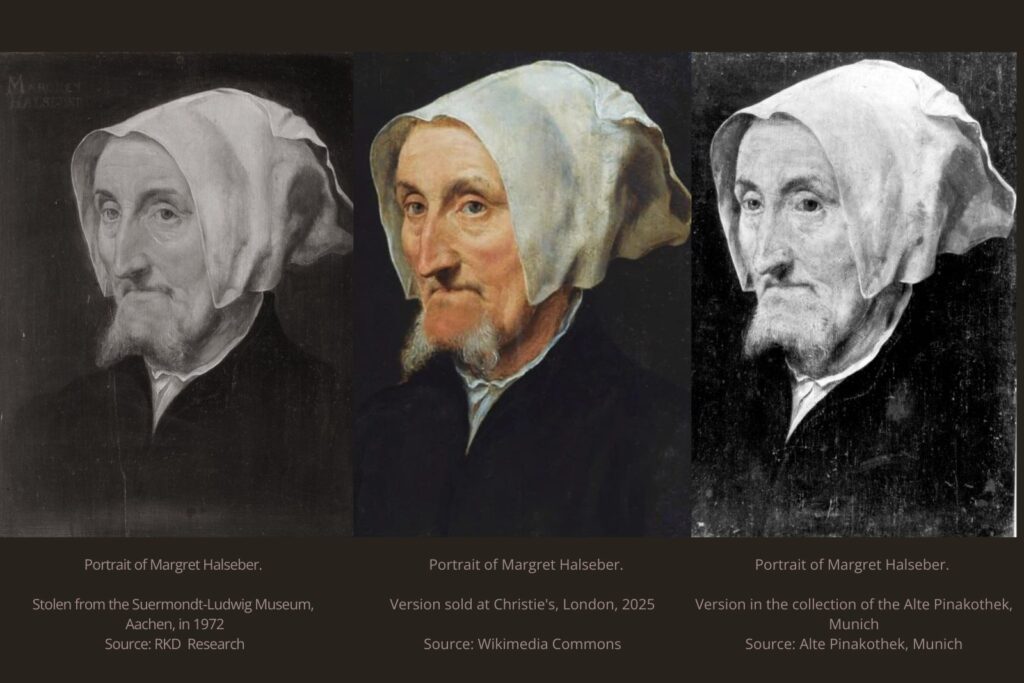
Today, the lost painting survives only in old black-and-white photographs and museum records. As a result, art historians are left to reconstruct the histories of several nearly identical works from auction catalogs, collection inventories, museum labels, archival photographs, and scattered references found in documents spanning four centuries. Perhaps it is no surprise, then, that the story still raises more questions than it answers.
Which of the known versions came first? Did the Christie’s painting once belong to Cardinal Granvelle? Why was the name Margret Halseber recorded only on the Aachen panel? And can we even be certain that every known version depicts the same woman? And perhaps the most important question remains unanswered. Will the stolen painting ever resurface? Because the missing panel is no longer just another version of the portrait. It may be the key to the entire story.
In this story, very little can be considered definitively proven. There is something almost fitting about the fact that one of the most memorable works in Bellezza e bruttezza is this very portrait. Mystery seems to surround it at every turn. A painting suspended between beauty and ugliness. Willem Key does not portray Margret as a curiosity, he does not turn her into an object of ridicule or reduce her to a medical oddity. What we see is not simply a “bearded woman.” We see an elderly person with tired eyes, wrinkles, a life of her own, and a sense of dignity that the artist preserves even where many of his contemporaries saw only the unusual. The portrait feels more alive, and more enigmatic, than many of the flawlessly beautiful faces painted during the same era.
There is one more intriguing detail.
Around 1800, an unidentified student at the art academy in Bruges produced an academic drawing based on an engraving of the portrait. The very existence of such a work suggests that the image of the bearded woman continued to circulate in artistic circles more than two centuries after the original painting was created. What makes the drawing especially remarkable, however, is something else. Beneath the portrait, the artist carefully rendered a decorative cartouche intended for the sitter’s name. Then he left it blank.
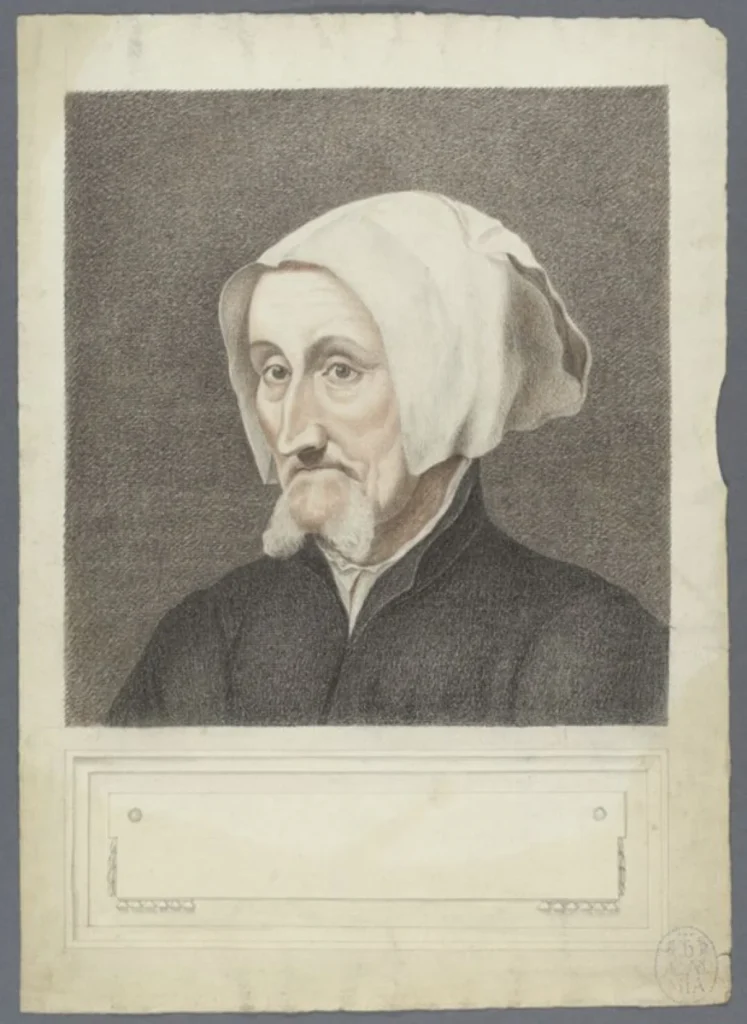
Perhaps the name was simply never added, or it was already missing from the image the student was copying.
It would be difficult to imagine a more fitting final detail for this story. History seems to erase her name again and again, leaving us with only her face.
Exhibition calendar
17 Sep 2026
European Art Exhibitions: Fall 2026
Europe’s fall exhibition season is officially underway, and this year there really is something…
Art news
03 Oct 2025
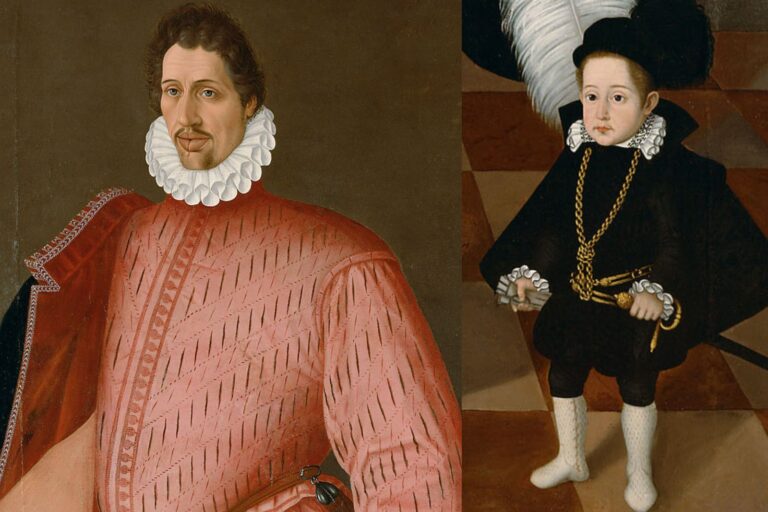
Double Portrait of a Giant and a Dwarf
“Dwarfs” and “giants” were long seen as curiosities of nature. In the Middle Ages…
Exhibition highlights

23 Nov 2025
The Art of the Nightmare at the the Musée Marmottan Monet
Sleep and nightmare, sleep and desire, sleep and death. The Musée Marmottan Monet in…
Best catalogs
Van Dyck, the European: The Journey from Antwerp to Genova and London
$49.00
The World of Gerard van Honthorst
$95.00
Maarten van Heemskerck
$103.00

Spanish Fashion in the Age of Velázquez: A Tailor at the Court of Philip IV
$57.00

Cartas de Colón. América en la Casa de Alba
$92.00
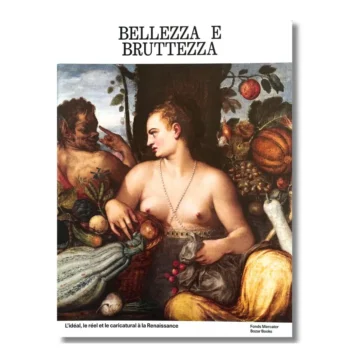
Bellezza e Bruttezza
$89.00
Global Baroque
$92.00
Unforgettable: Women Artists from Antwerp to Amsterdam, 1600–1750
$87.00